Ashley Rakahuri flood resilience project
Over the next several years, we’re planning to create new flood resilience measures along the 22km section of the Ashley Rakahuri that runs between the Ōkūkū River and Waikuku Beach.
Our goal is to strengthen flood resilience for Rangiora, Kaiapoi, Waikuku, and surrounding areas.
The feedback survey closed on 31 August 2026. You can still add comments in the design options section, ask questions in the questions and answers section, or email us at rivers.delivery@ecan.govt.nz
Feedback received by 5pm on Wednesday 30 September 2026 will also be considered as part of the options analysis process.
There will be further opportunities to have your say as the project progresses.
Why we’re doing this work now
Early flood protection works on the Ashley Rakahuri started in the 1930s. The existing stopbank scheme has protected the district for around 70 years, but over that time, the flood risk has increased.
- Recent events, such as the Kaikōura floods, Auckland Anniversary floods and Cyclone Gabrielle, have demonstrated that extreme rainfall and flooding are happening more often and causing greater damage than in the past. Scientific evidence shows these types of events are becoming more frequent and intense.
- There are now more people, homes, businesses and infrastructure located within the Ashley Rakahuri floodplains. This means the consequences of flooding are higher than they were when the scheme was first built. View our flood modelling maps to see the areas that could be affected during a 1‑in‑500‑year flood event.
- Our modelling shows there is a risk of floods breaking out at different points along the river. We want to ensure our flood protection reflects today’s risks and that they are fit for the future.
Our approach
As we follow the Ashley Rakahuri from its confluence with the Ōkūkū River to the coast, the river changes. Flood breakouts can travel in different directions and have different impacts in different places. That's why we're looking at the river in three reaches, each requiring different ways to manage breakout flooding risk.
Reaches:
Reach 1: Ōkūkū confluence → Rangiora Railway Bridge
Reach 2: Railway Bridge → SH1 Bridge
Reach 3: SH1 → the ocean
What options we're considering
We’re considering a range of possible solutions that may be combined. Different approaches may be needed for different parts of the river. These include:
- Upgrading or modifying the existing primary stopbank
- One or more secondary stopbanks
- Managed floodways
- Stopbank retreat
- Berm vegetation management
- Wetland creation / room-for-the-river approaches
- Gravel management
At this early, investigative stage of the project, we have no preferred option/s. Your feedback will help select a preferred option by correcting our assumptions and highlighting unintended consequences. This will be balanced with other criteria such as safety, practicality for land use, environmental and cultural outcomes, feasibility and cost.
Have your say on flood resilience options
- View the current design options and add your comments
- You can provide feedback by using the questions and answers section, or emailing rivers.delivery@ecan.govt.nz until 5pm on 31 September 2026.
- Read more information about the project details, timeline and how decisions will be made.
- View flood modelling maps based on a 1-in-500-year flood event
- Sign up for updates: Join the mailing list in the 'Stay Informed' area of this page
-
8 Responses
A secondary stopbank extending from the terrace on Mount Thomas Road to the east of the racecourse
This option would see us building a second stopbank further south of the river, starting at the terrace on Mount Thomas Road and connecting back to the primary stopbank just east of the racecourse.
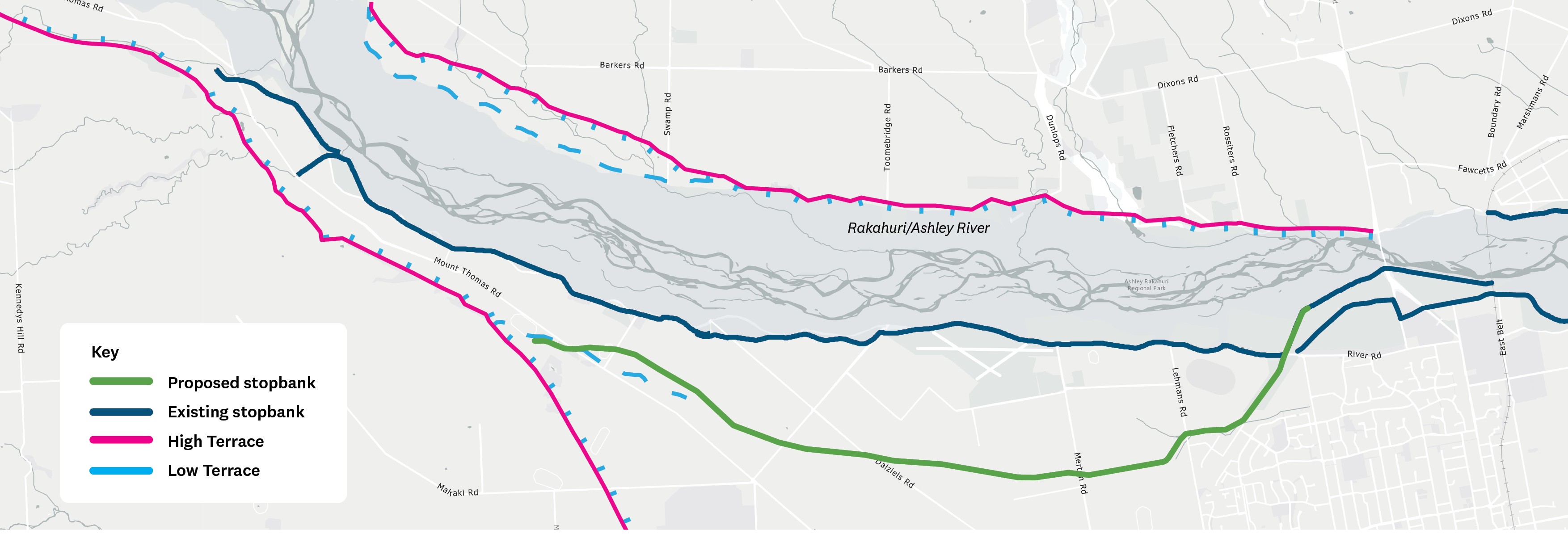 Option A: A secondary stopbank extending from the terrace on Mount Thomas Road to the east of the racecourse
Pros
This provides two levels of protection for the urban areas of Rangiora and Kaiapoi, as well as the rural areas that are currently within the modelled flow paths for breakouts between the Ōkūkū to Rangiora
Cons
This is the longest alignment
The option crosses a significant number of properties
This option wouldn’t improve flood protection for properties in between the primary and secondary stopbanks, and would increase flood depths for some of these properties
Note the options included here are for the part of the river that extends from the Ōkūkū confluence to Rangiora Railway Bridge. We will share design options for downstream areas later in 2026. You can add comments directly to these options or give your feedback via the give feedback section of the page.
Please note that comments you make in this section will appear publicly, so please protect your personal privacy and the privacy of others. Do not share personable or confidential information in this section.
Please remain polite and respectful of others and their opinions. We may remove content that contains: Racism or hate speech, disrespectful, rude, or abusive language, threats to another person or organisation, including us and our employees, potentially defamatory statements, spam or links to external sites, off-topic information irrelevant to the thread, obscene, offensive, harassing, or discriminatory content toward any person or organisation, including us and our employees.Go to discussion -
A secondary stopbank from the terrace opposite Groyne 8 to the east of the airfield
This option would involve building a second stopbank further south of the river, starting around Groyne 8 and connecting back to the primary stopbank just east of the airfield.
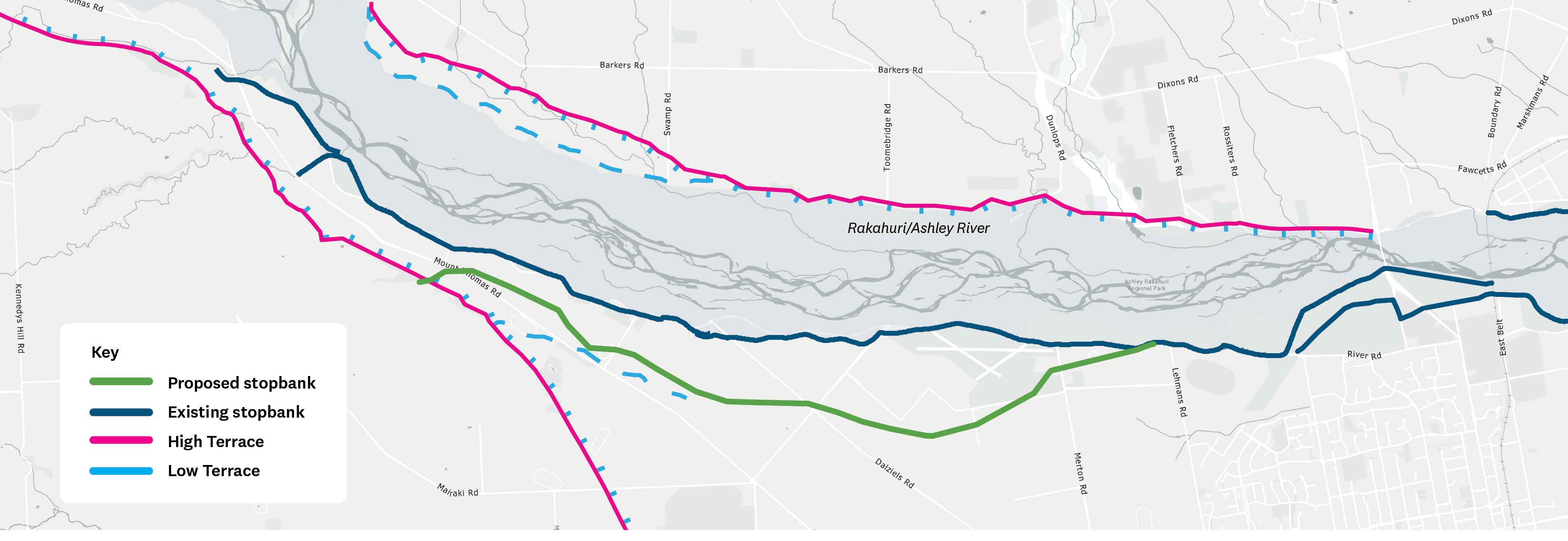 Option B: A secondary stopbank from the terrace opposite Groyne 8 to the east of the airfield
Pros
- This would maximise the length of secondary stopbank protection
- This option would provide increased flood protection for more people living on the south of the stopbank
Cons
- This option would have implications for potential land development south of the airfield
- Constriction of breakout flow where the proposed bank first crosses Mount Thomas Road, requiring mitigation for high water velocities
Note the options included here are for the part of the river that extends from the Ōkūkū confluence to Rangiora Railway Bridge. We will share design options for downstream areas later in 2026. You can add comments directly to these options or give your feedback via the give feedback section of the page.
Please note that comments you make in this section will appear publicly, so please protect your personal privacy and the privacy of others. Do not share personable or confidential information in this section.
Please remain polite and respectful of others and their opinions. We may remove content that contains: Racism or hate speech, disrespectful, rude, or abusive language, threats to another person or organisation, including us and our employees, potentially defamatory statements, spam or links to external sites, off-topic information irrelevant to the thread, obscene, offensive, harassing, or discriminatory content toward any person or organisation, including us and our employees. -
A secondary stopbank starting at the low terrace across Mount Thomas Road from Groyne 7 to the east of the airfield
This option would see us building a second stopbank south of the river, starting south of Groyne 7 and connecting back to the primary stopbank just east of the airfield.
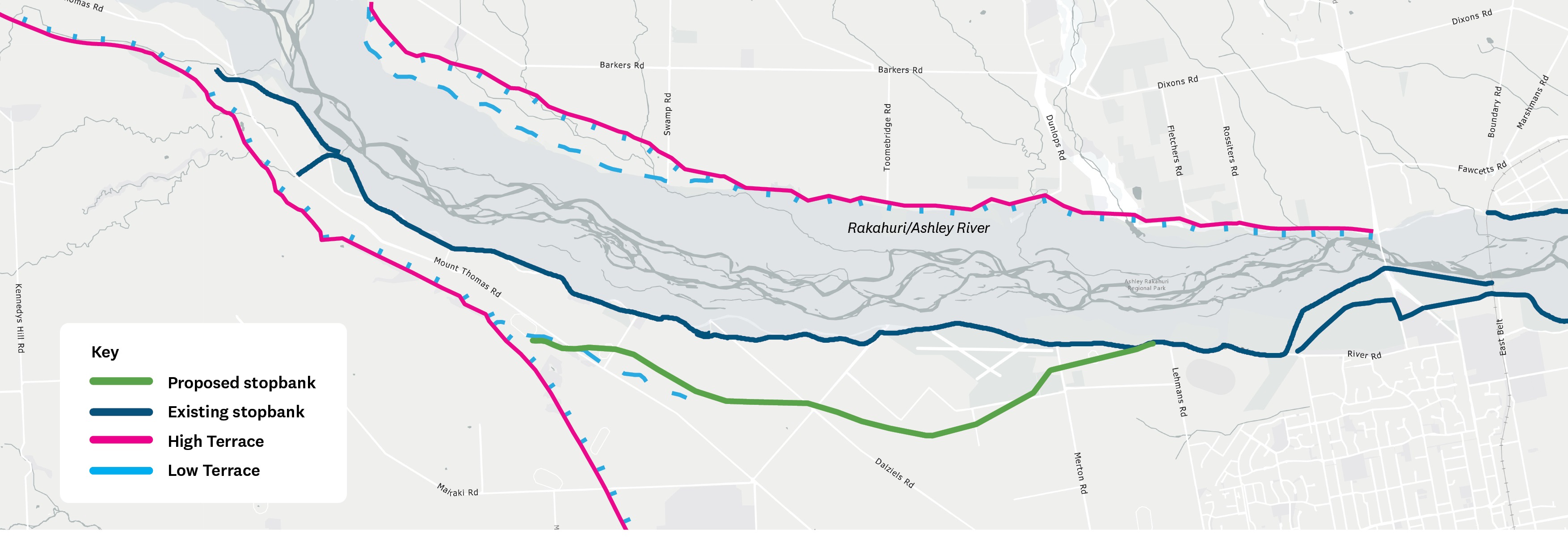 Option C: A secondary stopbank starting at the low terrace across Mount Thomas Road from Groyne 7 to the east of the airfield
Pros
- As with option B, this option would maximise the length of secondary stopbank protection, meaning:
- It would provide increased flood protection for people living on the south of the stopbank
- This has the benefit of incorporating more natural terrain features into the design, which will minimise earthworks when we come to construction
Cons
- This option would have implications for potential land development south of the airfield
- Many dwellings within existing breakout flow towards the west of the river (the Ōkūkū confluence) would not get additional protection
Note the options included here are for the part of the river that extends from the Ōkūkū confluence to Rangiora Railway Bridge. We will share design options for downstream areas later in 2026. You can add comments directly to these options or give your feedback via the give feedback section of the page.
Please note that comments you make in this section will appear publicly, so please protect your personal privacy and the privacy of others. Do not share personable or confidential information in this section.
Please remain polite and respectful of others and their opinions. We may remove content that contains: Racism or hate speech, disrespectful, rude, or abusive language, threats to another person or organisation, including us and our employees, potentially defamatory statements, spam or links to external sites, off-topic information irrelevant to the thread, obscene, offensive, harassing, or discriminatory content toward any person or organisation, including us and our employees. - As with option B, this option would maximise the length of secondary stopbank protection, meaning:
-
A series of shorter secondary stopbanks upstream of Groyne 7
This option would see us build a short secondary stopbank from the confluence of the Ōkūkū River, which returns the breakout flow around Groyne 7.
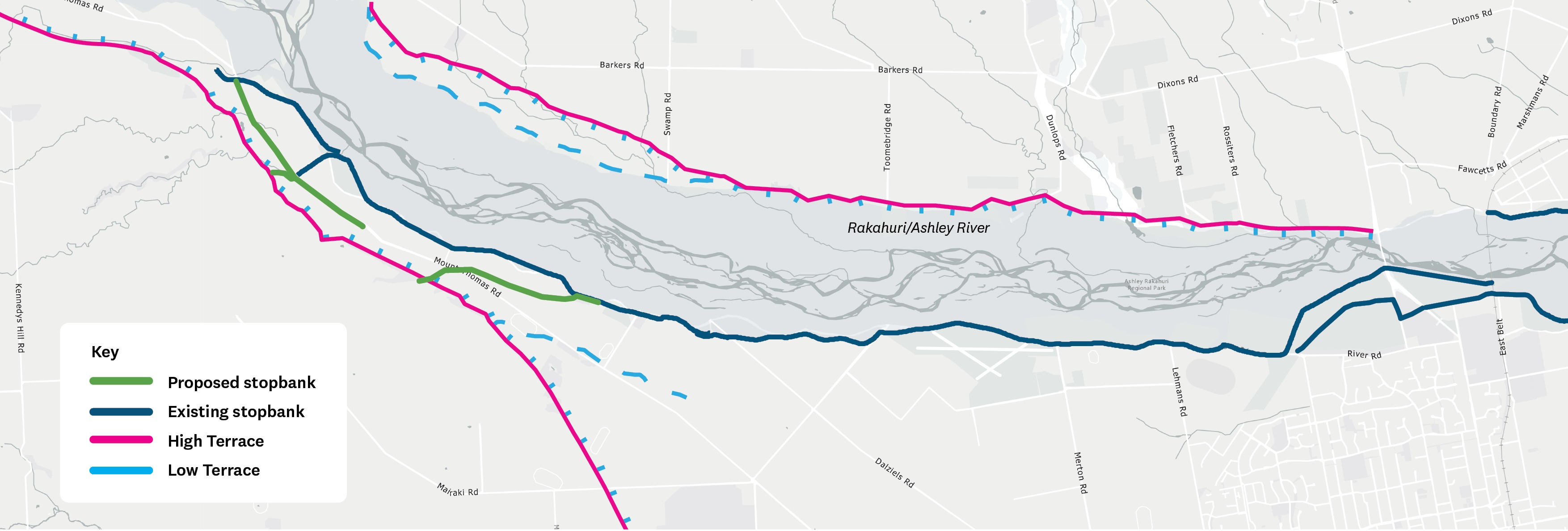 Option D: A series of shorter secondary stopbanks upstream of Groyne 7
Pros
- This is the shortest option, which minimises impact on people living in the area in relation to impact on land and construction
- It focuses on the high-risk section where two rivers meet
- It could be a standalone option, or used in conjunction with the other options
Cons
- It doesn’t address the risk of the primary stopbank failing further downstream
- Its efficacy would rely on extensive primary stopbank upgrades (these may be implemented anyway)
Note the options included here are for the part of the river that extends from the Ōkūkū confluence to Rangiora Railway Bridge. We will share design options for downstream areas later in 2026. You can add comments directly to these options or give your feedback via the give feedback section of the page.
Please note that comments you make in this section will appear publicly, so please protect your personal privacy and the privacy of others. Do not share personable or confidential information in this section.
Please remain polite and respectful of others and their opinions. We may remove content that contains: Racism or hate speech, disrespectful, rude, or abusive language, threats to another person or organisation, including us and our employees, potentially defamatory statements, spam or links to external sites, off-topic information irrelevant to the thread, obscene, offensive, harassing, or discriminatory content toward any person or organisation, including us and our employees. -
A secondary stopbank starting at the low terrace across Mount Thomas Road from Groyne 7 and joining the primary stopbank west of the airfield
This option would see us constructing a secondary stopbank starting at the low terrace on Mount Thomas Road and joining the primary stopbank along Priors Road, to the west of the airfield.
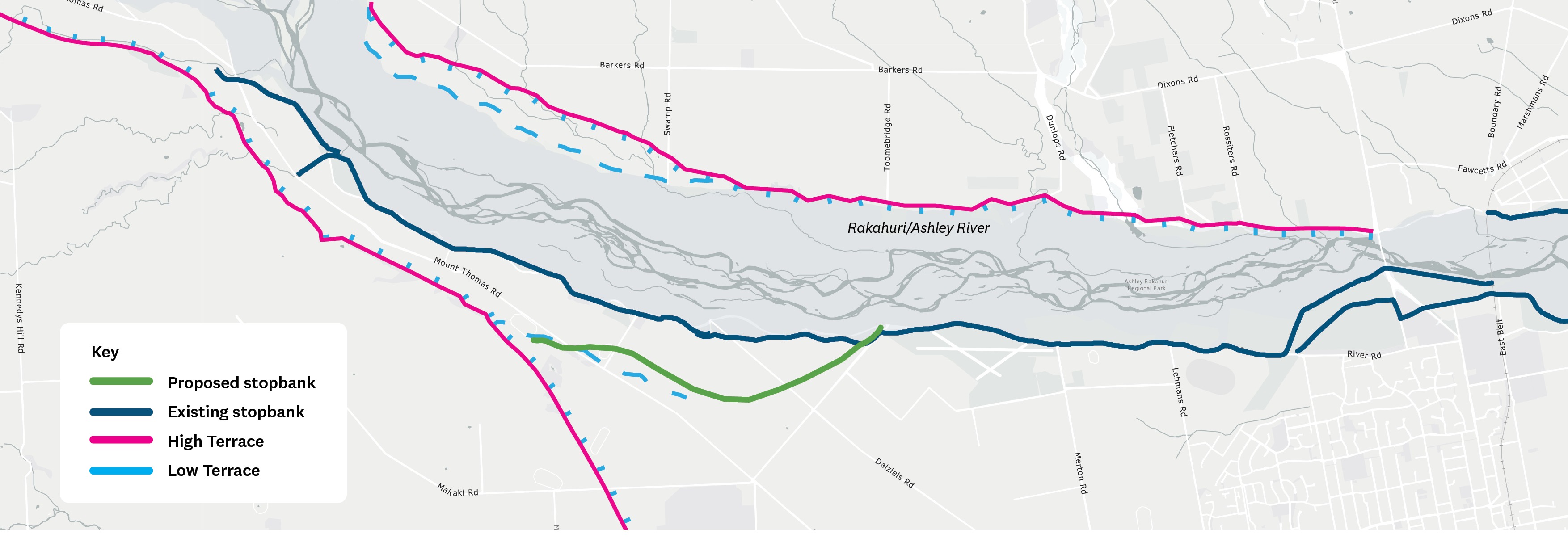 Option E: A secondary stopbank starting at the low terrace across Mount Thomas Road from Groyne 7 and joining the primary stopbank west of the airfield Pros
- This is a shorter alignment
- It reduces the impact of land use and construction impact on neighbouring properties
Cons
- If the primary stopbank failed, there would be no additional protection between the airfield and Cones Road
- Requires extensive upgrades to primary stopbank from airfield to Cones Road
Note the options included here are for the part of the river that extends from the Ōkūkū confluence to Rangiora Railway Bridge. We will share design options for downstream areas later in 2026. You can add comments directly to these options or give your feedback via the give feedback section of the page.
Please note that comments you make in this section will appear publicly, so please protect your personal privacy and the privacy of others. Do not share personable or confidential information in this section.
Please remain polite and respectful of others and their opinions. We may remove content that contains: Racism or hate speech, disrespectful, rude, or abusive language, threats to another person or organisation, including us and our employees, potentially defamatory statements, spam or links to external sites, off-topic information irrelevant to the thread, obscene, offensive, harassing, or discriminatory content toward any person or organisation, including us and our employees. -
Upgrading the existing stopbank network
This option considers upgrading the existing stopbanks, keeping the existing alignment the same (likely with a wider footprint), and increasing the height. Engineered erosion protection and strengthening measures such as rock protection and groynes would be required to increase resilience.
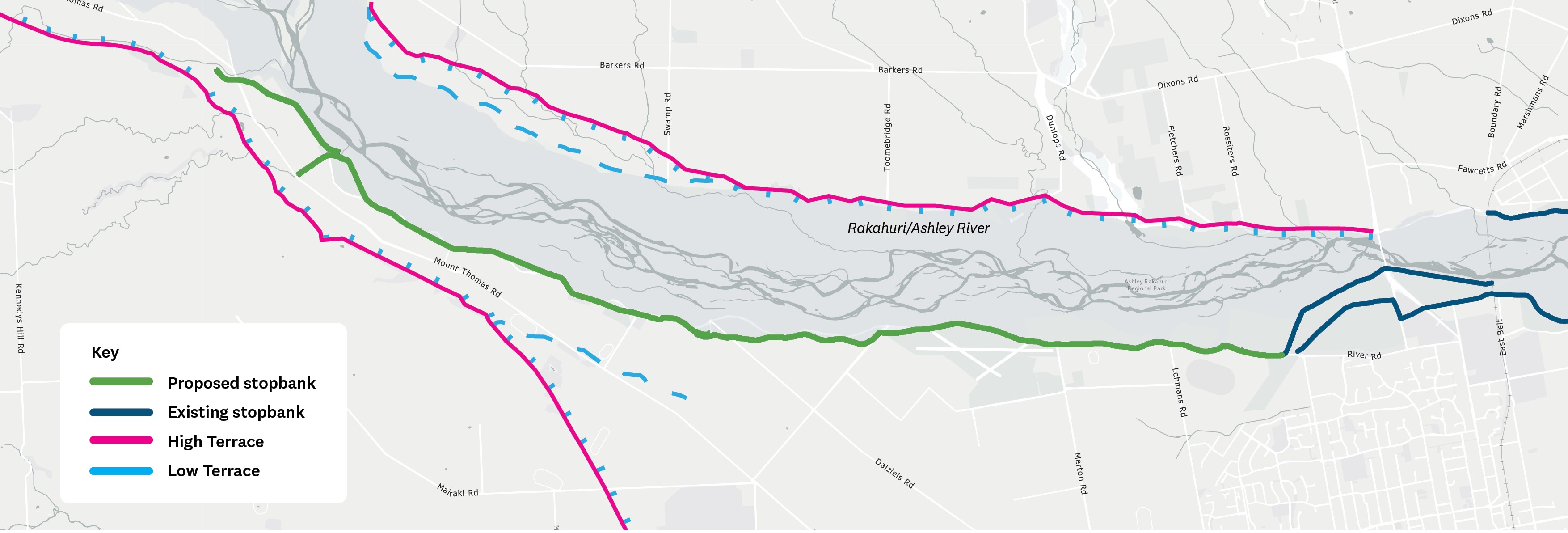 Option F: Upgrading the existing stopbank network
Pros
- This option minimises impact to private property as it follows the existing alignment
- Stopbank upgrades are likely to be required in some sections regardless of any alternative option selected
- Minimal impact on proposed developments and existing activities
Cons
- No backup protection if floodwaters overtop or erode the stopbank
- A higher stopbank allows the river to carry more water, which means better protection in most circumstances but potentially greater impacts for nearby properties if the stopbank is damaged during an extreme flood
- Extent of strengthening could be significant as erosion can occur anywhere along the stopbank system
Note the options included here are for the part of the river that extends from the Ōkūkū confluence to Rangiora Railway Bridge. We will share design options for downstream areas later in 2026. You can add comments directly to these options or give your feedback via the give feedback section of the page.
Please note that comments you make in this section will appear publicly, so please protect your personal privacy and the privacy of others. Do not share personable or confidential information in this section.
Please remain polite and respectful of others and their opinions. We may remove content that contains: Racism or hate speech, disrespectful, rude, or abusive language, threats to another person or organisation, including us and our employees, potentially defamatory statements, spam or links to external sites, off-topic information irrelevant to the thread, obscene, offensive, harassing, or discriminatory content toward any person or organisation, including us and our employees. -
Primary stopbank upgrades: upgrading existing stopbanks where required
As with Reach 1, this option proposes raising and strengthening existing stopbanks where required to increase the level of flood protection provided. A geotechnical engineering consultant is investigating how and where this is possible.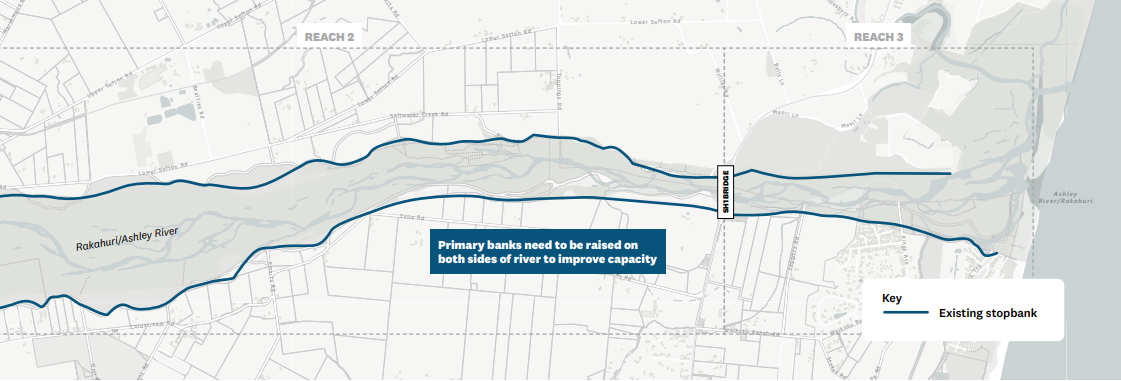 Option F (Reach 2&3): Primary stopbank upgrades
Pros
- Minimises impacts on private land
Cons
- Doesn't address flow restrictions at the SH1 bridge, so a spillway may still be required.
- May not be feasible to upgrade all sections of stopbank..
Note: You can add comments directly to these options or give your feedback via the give feedback section of the page.
Please note that comments you make in this section will appear publicly, so please protect your personal privacy and the privacy of others. Do not share personable or confidential information in this section.
Please remain polite and respectful of others and their opinions. We may remove content that contains: Racism or hate speech, disrespectful, rude, or abusive language, threats to another person or organisation, including us and our employees, potentially defamatory statements, spam or links to external sites, off-topic information irrelevant to the thread, obscene, offensive, harassing, or discriminatory content toward any person or organisation, including us and our employees. -
Stopbank retreat on Environment Canterbury-owned land
This option proposes building a new stopbank on Environment Canterbury-owned land on the north side of the river and, once established, lowering or removing sections of the existing stopbank.
For both Option G1 and Option G2, new flood protection vegetation would be planted and allowed to establish before the existing stopbank is lowered or removed.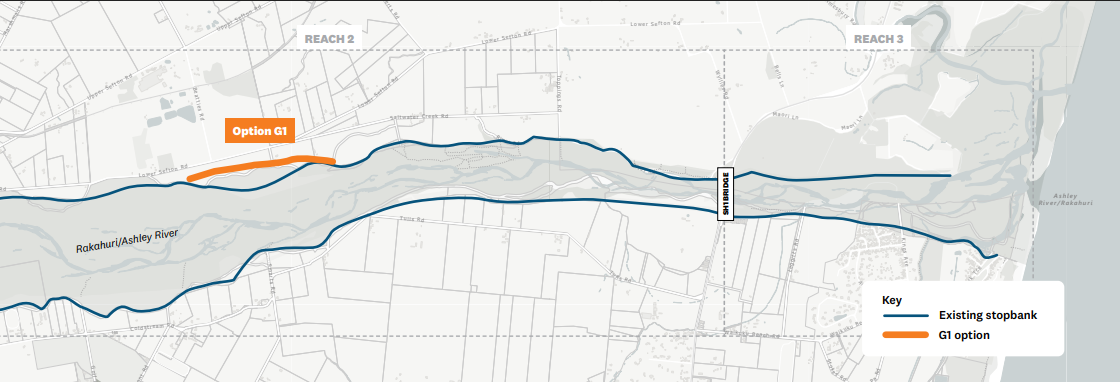 Option G1: Stopbank retreat on Environment Canterbury
 Pros
- Increases flood-carrying capacity in this section.
- Reduces constriction created by the existing stopbank alignment.
- Primarily uses Environment Canterbury-owned land.
Cons
- Will take time for new flood protection vegetation to establish.
- Addresses capacity issues over a relatively short section of the scheme (1.2 km).
Note: You can add comments directly to these options or give your feedback via the give feedback section of the page.
Please note that comments you make in this section will appear publicly, so please protect your personal privacy and the privacy of others. Do not share personable or confidential information in this section.
Please remain polite and respectful of others and their opinions. We may remove content that contains: Racism or hate speech, disrespectful, rude, or abusive language, threats to another person or organisation, including us and our employees, potentially defamatory statements, spam or links to external sites, off-topic information irrelevant to the thread, obscene, offensive, harassing, or discriminatory content toward any person or organisation, including us and our employees. -
Managed spillway: Engineered spillway on north side of the river upstream of the SH1 bridge
The State Highway 1 bridge limits how much water can safely pass through this section of the river during flood events.
If flood capacity is increased, a spillway could be used to allow water to overflow from the river in a controlled manner to the north and into either Saltwater Creek or across the highway and into the estuary.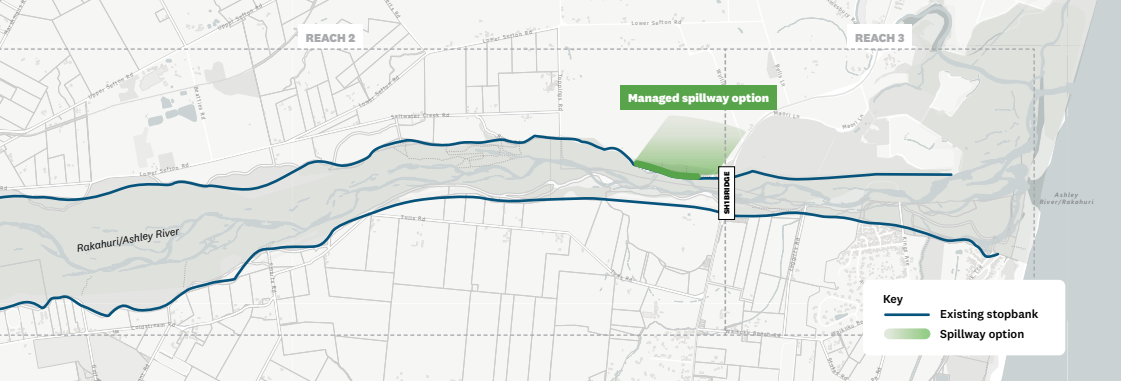 Option H: Managed spillway. Engineered spillway on north side of the river, upstream of the SH1 bridge
- Note that the shaded area is indicative only and does not represent exact flows.
Pros
- Reduces flood pressure on the SH1 bridge.
- Improves flood protection for Waikuku.
- Allows overflows to occur in a controlled and predictable way.
- Guidebanks can help direct flood flows along a defined path.
Cons
- Will result in flooding of properties within the floodway when activated (likely in excess of 3,000 cumecs, almost twice the recorded peak flow in May 2021).
- Some properties in this area are at risk of flooding under existing conditions.
Note: You can add comments directly to these options or give your feedback via the give feedback section of the page.
Please note that comments you make in this section will appear publicly, so please protect your personal privacy and the privacy of others. Do not share personable or confidential information in this section.
Please remain polite and respectful of others and their opinions. We may remove content that contains: Racism or hate speech, disrespectful, rude, or abusive language, threats to another person or organisation, including us and our employees, potentially defamatory statements, spam or links to external sites, off-topic information irrelevant to the thread, obscene, offensive, harassing, or discriminatory content toward any person or organisation, including us and our employees.