-
A secondary stopbank extending from the terrace on Mount Thomas Road to the east of the racecourse
This option would see us building a second stopbank further south of the river, starting at the terrace on Mount Thomas Road and connecting back to the primary stopbank just east of the racecourse.
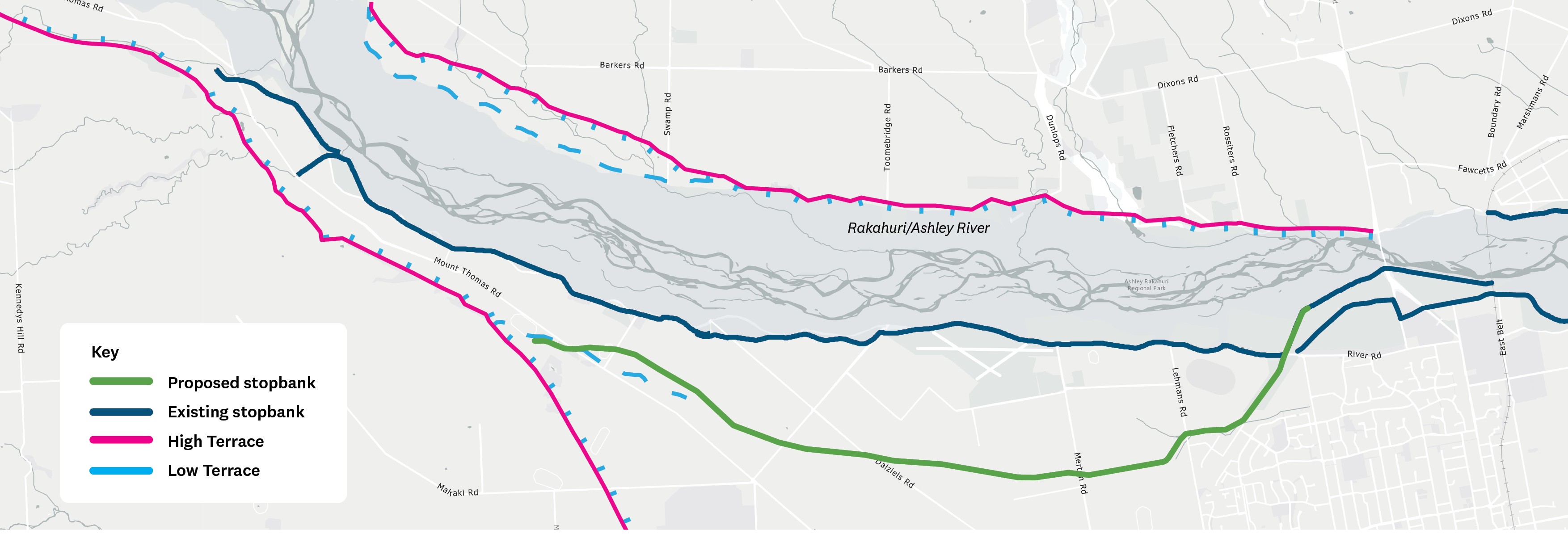 Option A: A secondary stopbank extending from the terrace on Mount Thomas Road to the east of the racecourse
Pros
This provides two levels of protection for the urban areas of Rangiora and Kaiapoi, as well as the rural areas that are currently within the modelled flow paths for breakouts between the Ōkūkū to Rangiora
Cons
This is the longest alignment
The option crosses a significant number of properties
This option wouldn’t improve flood protection for properties in between the primary and secondary stopbanks, and would increase flood depths for some of these properties
Note the options included here are for the part of the river that extends from the Ōkūkū confluence to Rangiora Railway Bridge. We will share design options for downstream areas later in 2026. You can add comments directly to these options or give your feedback via the give feedback section of the page.
Please note that comments you make in this section will appear publicly, so please protect your personal privacy and the privacy of others. Do not share personable or confidential information in this section.
Please remain polite and respectful of others and their opinions. We may remove content that contains: Racism or hate speech, disrespectful, rude, or abusive language, threats to another person or organisation, including us and our employees, potentially defamatory statements, spam or links to external sites, off-topic information irrelevant to the thread, obscene, offensive, harassing, or discriminatory content toward any person or organisation, including us and our employees.Go to discussion -
A secondary stopbank from the terrace opposite Groyne 8 to the east of the airfield
This option would involve building a second stopbank further south of the river, starting around Groyne 8 and connecting back to the primary stopbank just east of the airfield.
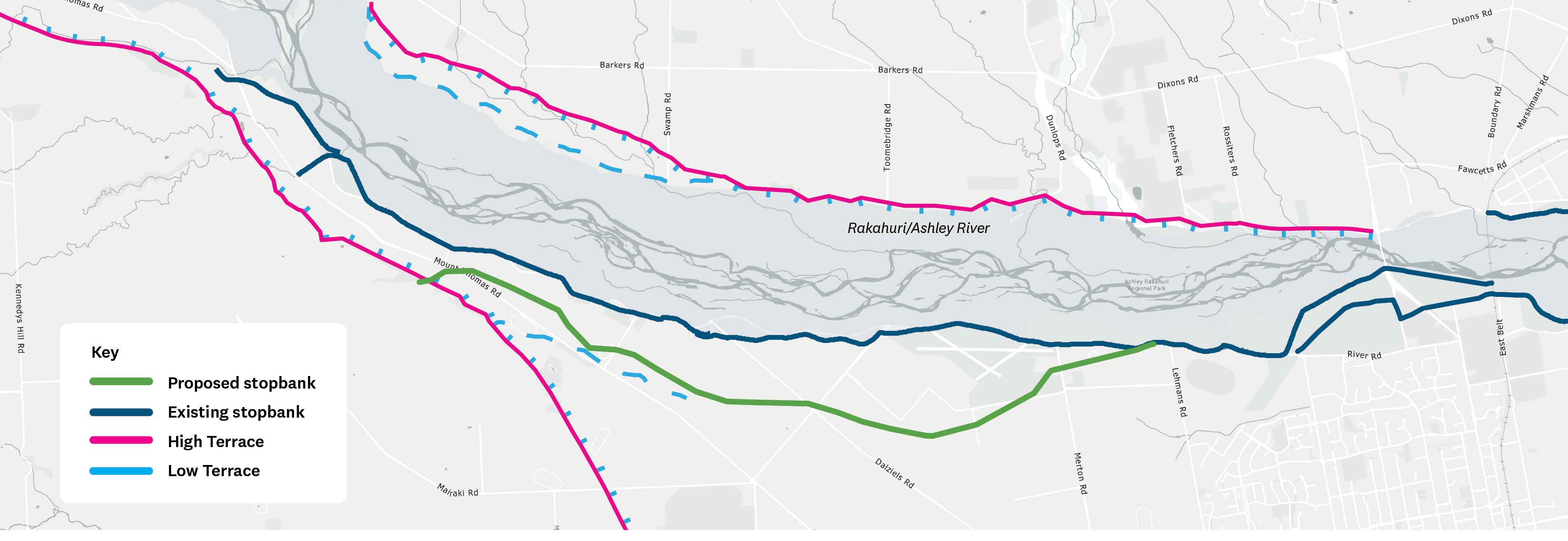 Option B: A secondary stopbank from the terrace opposite Groyne 8 to the east of the airfield
Pros
- This would maximise the length of secondary stopbank protection
- This option would provide increased flood protection for more people living on the south of the stopbank
Cons
- This option would have implications for potential land development south of the airfield
- Constriction of breakout flow where the proposed bank first crosses Mount Thomas Road, requiring mitigation for high water velocities
Note the options included here are for the part of the river that extends from the Ōkūkū confluence to Rangiora Railway Bridge. We will share design options for downstream areas later in 2026. You can add comments directly to these options or give your feedback via the give feedback section of the page.
Please note that comments you make in this section will appear publicly, so please protect your personal privacy and the privacy of others. Do not share personable or confidential information in this section.
Please remain polite and respectful of others and their opinions. We may remove content that contains: Racism or hate speech, disrespectful, rude, or abusive language, threats to another person or organisation, including us and our employees, potentially defamatory statements, spam or links to external sites, off-topic information irrelevant to the thread, obscene, offensive, harassing, or discriminatory content toward any person or organisation, including us and our employees. -
A secondary stopbank starting at the low terrace across Mount Thomas Road from Groyne 7 to the east of the airfield
This option would see us building a second stopbank south of the river, starting south of Groyne 7 and connecting back to the primary stopbank just east of the airfield.
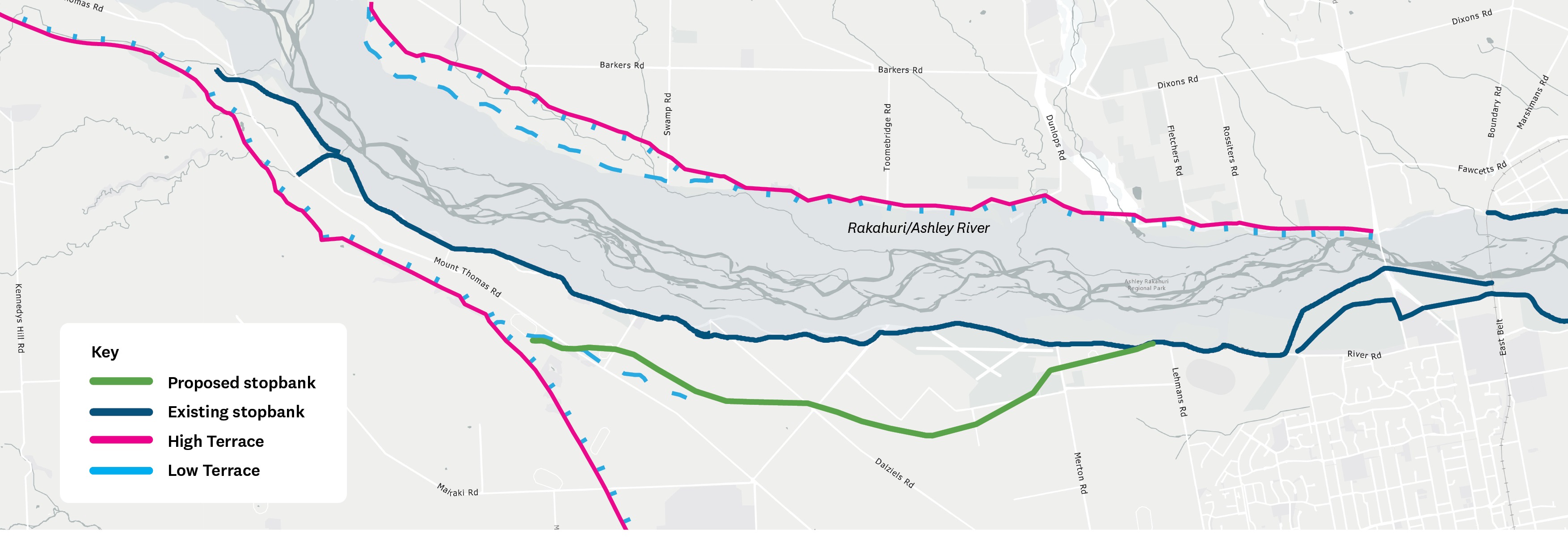 Option C: A secondary stopbank starting at the low terrace across Mount Thomas Road from Groyne 7 to the east of the airfield
Pros
- As with option B, this option would maximise the length of secondary stopbank protection, meaning:
- It would provide increased flood protection for people living on the south of the stopbank
- This has the benefit of incorporating more natural terrain features into the design, which will minimise earthworks when we come to construction
Cons
- This option would have implications for potential land development south of the airfield
- Many dwellings within existing breakout flow towards the west of the river (the Ōkūkū confluence) would not get additional protection
Note the options included here are for the part of the river that extends from the Ōkūkū confluence to Rangiora Railway Bridge. We will share design options for downstream areas later in 2026. You can add comments directly to these options or give your feedback via the give feedback section of the page.
Please note that comments you make in this section will appear publicly, so please protect your personal privacy and the privacy of others. Do not share personable or confidential information in this section.
Please remain polite and respectful of others and their opinions. We may remove content that contains: Racism or hate speech, disrespectful, rude, or abusive language, threats to another person or organisation, including us and our employees, potentially defamatory statements, spam or links to external sites, off-topic information irrelevant to the thread, obscene, offensive, harassing, or discriminatory content toward any person or organisation, including us and our employees. - As with option B, this option would maximise the length of secondary stopbank protection, meaning:
-
A series of shorter secondary stopbanks upstream of Groyne 7
This option would see us build a short secondary stopbank from the confluence of the Ōkūkū River, which returns the breakout flow around Groyne 7.
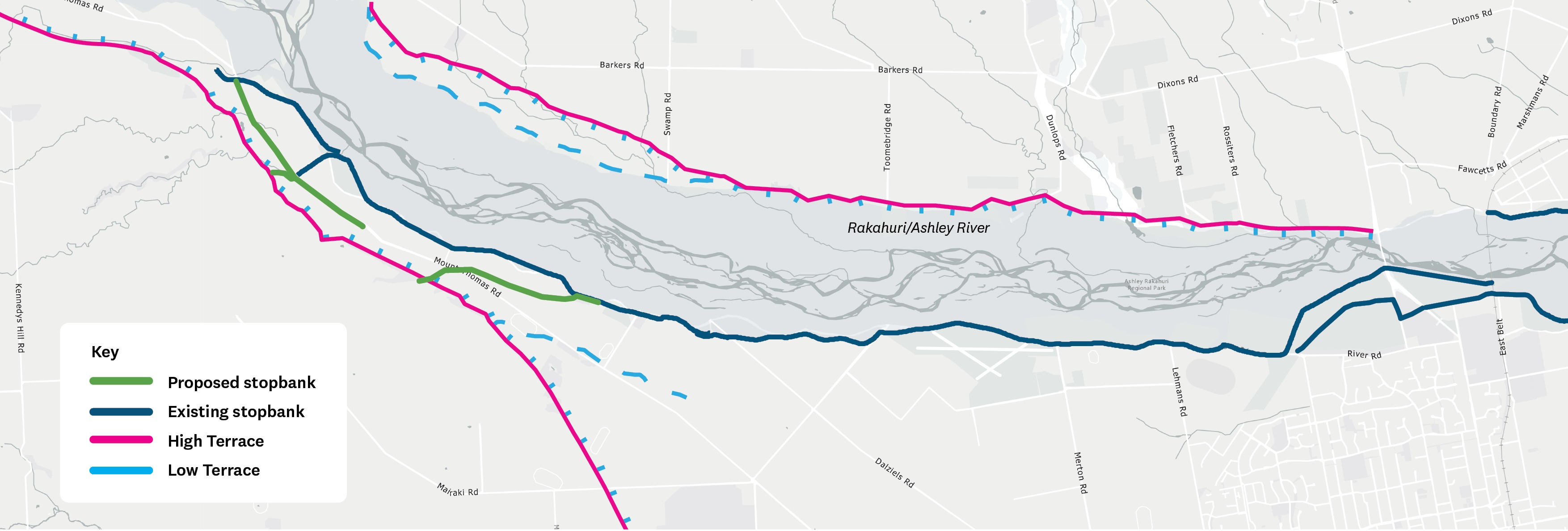 Option D: A series of shorter secondary stopbanks upstream of Groyne 7
Pros
- This is the shortest option, which minimises impact on people living in the area in relation to impact on land and construction
- It focuses on the high-risk section where two rivers meet
- It could be a standalone option, or used in conjunction with the other options
Cons
- It doesn’t address the risk of the primary stopbank failing further downstream
- Its efficacy would rely on extensive primary stopbank upgrades (these may be implemented anyway)
Note the options included here are for the part of the river that extends from the Ōkūkū confluence to Rangiora Railway Bridge. We will share design options for downstream areas later in 2026. You can add comments directly to these options or give your feedback via the give feedback section of the page.
Please note that comments you make in this section will appear publicly, so please protect your personal privacy and the privacy of others. Do not share personable or confidential information in this section.
Please remain polite and respectful of others and their opinions. We may remove content that contains: Racism or hate speech, disrespectful, rude, or abusive language, threats to another person or organisation, including us and our employees, potentially defamatory statements, spam or links to external sites, off-topic information irrelevant to the thread, obscene, offensive, harassing, or discriminatory content toward any person or organisation, including us and our employees. -
A secondary stopbank starting at the low terrace across Mount Thomas Road from Groyne 7 and joining the primary stopbank west of the airfield
This option would see us constructing a secondary stopbank starting at the low terrace on Mount Thomas Road and joining the primary stopbank along Priors Road, to the west of the airfield.
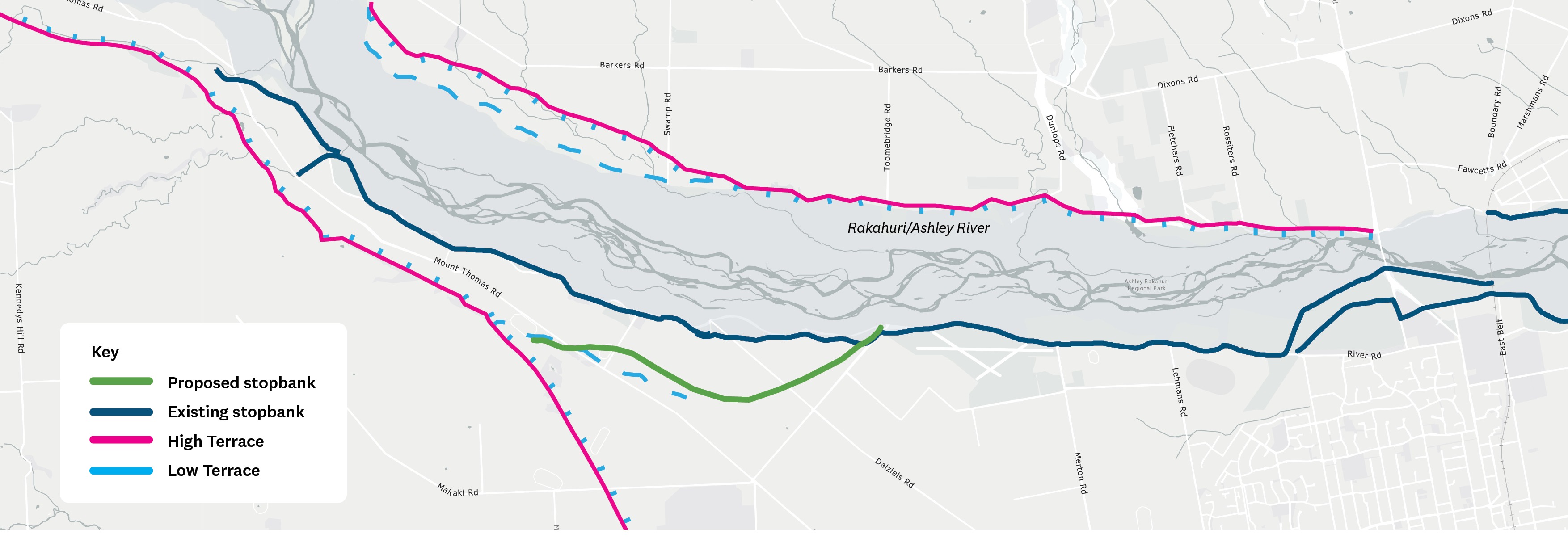 Option E: A secondary stopbank starting at the low terrace across Mount Thomas Road from Groyne 7 and joining the primary stopbank west of the airfield Pros
- This is a shorter alignment
- It reduces the impact of land use and construction impact on neighbouring properties
Cons
- If the primary stopbank failed, there would be no additional protection between the airfield and Cones Road
- Requires extensive upgrades to primary stopbank from airfield to Cones Road
Note the options included here are for the part of the river that extends from the Ōkūkū confluence to Rangiora Railway Bridge. We will share design options for downstream areas later in 2026. You can add comments directly to these options or give your feedback via the give feedback section of the page.
Please note that comments you make in this section will appear publicly, so please protect your personal privacy and the privacy of others. Do not share personable or confidential information in this section.
Please remain polite and respectful of others and their opinions. We may remove content that contains: Racism or hate speech, disrespectful, rude, or abusive language, threats to another person or organisation, including us and our employees, potentially defamatory statements, spam or links to external sites, off-topic information irrelevant to the thread, obscene, offensive, harassing, or discriminatory content toward any person or organisation, including us and our employees. -
Upgrading the existing stopbank network
This option considers upgrading the existing stopbanks, keeping the existing alignment the same (likely with a wider footprint), and increasing the height. Engineered erosion protection and strengthening measures such as rock protection and groynes would be required to increase resilience.
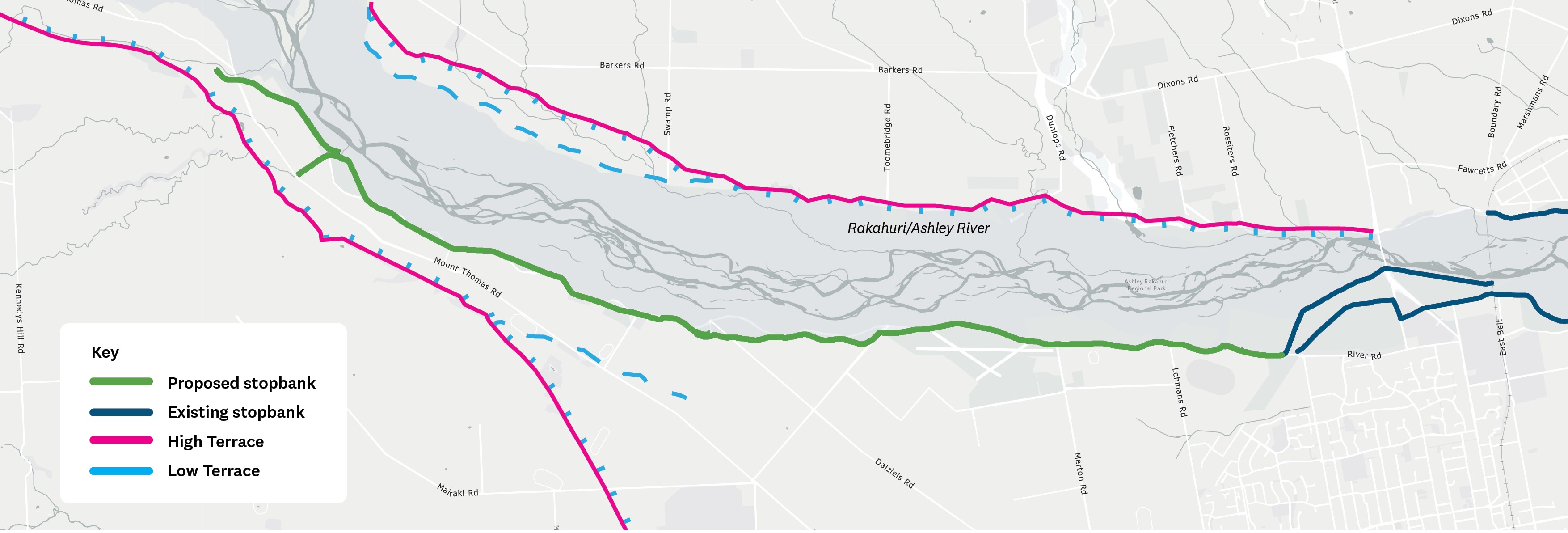 Option F: Upgrading the existing stopbank network
Pros
- This option minimises impact to private property as it follows the existing alignment
- Stopbank upgrades are likely to be required in some sections regardless of any alternative option selected
- Minimal impact on proposed developments and existing activities
Cons
- No backup protection if floodwaters overtop or erode the stopbank
- A higher stopbank allows the river to carry more water, which means better protection in most circumstances but potentially greater impacts for nearby properties if the stopbank is damaged during an extreme flood
- Extent of strengthening could be significant as erosion can occur anywhere along the stopbank system
Note the options included here are for the part of the river that extends from the Ōkūkū confluence to Rangiora Railway Bridge. We will share design options for downstream areas later in 2026. You can add comments directly to these options or give your feedback via the give feedback section of the page.
Please note that comments you make in this section will appear publicly, so please protect your personal privacy and the privacy of others. Do not share personable or confidential information in this section.
Please remain polite and respectful of others and their opinions. We may remove content that contains: Racism or hate speech, disrespectful, rude, or abusive language, threats to another person or organisation, including us and our employees, potentially defamatory statements, spam or links to external sites, off-topic information irrelevant to the thread, obscene, offensive, harassing, or discriminatory content toward any person or organisation, including us and our employees.
Discussions
All (6)
Open (6)