Takapō River tree removal
Thank you for taking the time to share your views on the tree removal proposal.
We heard a range of feedback, particularly about the impact on nearby residents, the stability of the riverbank on the true left side, and options for replanting.
Based on this feedback, we’re making some changes to how we approach this work.
- We won't start work on the true left riverbank this financial year as planned, while we take more time to better understand the risks and options.
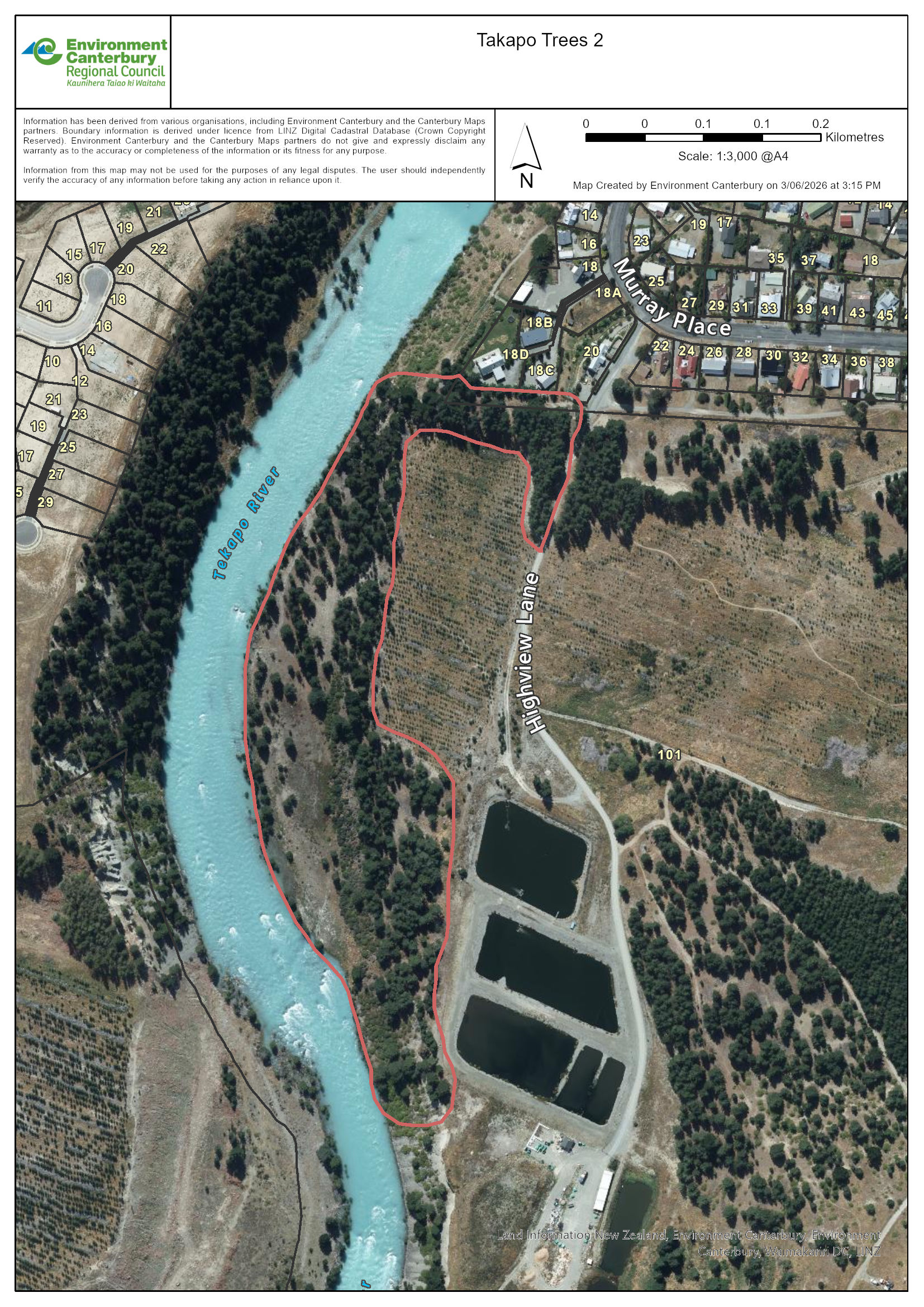
- We'll work with Mackenzie District Council and contractors this financial year to remove the fire risk trees close to Murray Place and the pest trees downstream away from the residential area - refer to attached map.
- We are exploring whether there is additional geotechnical information we can gather to support decision-making, while recognising that a full report isn't feasible.
- We are working with stakeholders on what a replanting plan could look like.
We know this is an important issue for the community, and we want to take the time to get the approach right.
We’ll continue to keep you updated as this work progresses.
If you have any questions, please contact:
Environment Canterbury: Sam Kidner - sam.kidner@ecan.govt.nz
Mackenzie District Council: Matthew Lanyon - matthew.lanyon@mackenzie.govt.nz
-
Where work will start
Takapō River tree removal
WHAT: Contractors for Environment Canterbury and Mackenzie District Council will be removing selected trees and vegetation along the true left of the Takapō River - see map for location.
Work will include:
- Removing selected trees and vegetation
- Clearing debris from the river corridor
- Processing material on site at a skidding site off Highfield Road
- Removing usable wood from site
- Chipping and spreading smaller material on site
- Reinstating the site once work is complete
WHEN:
Work is expected to start in June and will take several weeks to complete.
Work will take place during daytime hours, Monday to Friday.WHY:
This work will help:
- Reduce fire risk to nearby homes, visitors and recreation areas
- Limit the spread of wilding conifers along the river corridor
What to expect:
During this time you may notice:
- Machinery operating in the river corridor
- Increased vehicle movements near access points including Highview Lane
- Temporary noise and disruption
- Temporary restrictions to some public access areas to keep people safe